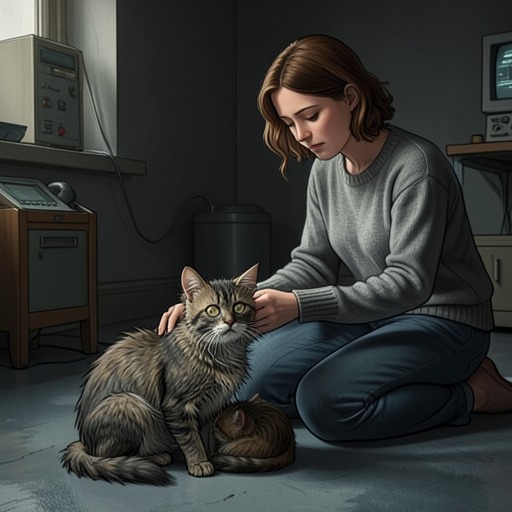
Booger’s Rescue and Adoption
What Are You Going ThroughBooger’s rescue and adoption is a story of repeated displacement ending in care: after a fire destroys the convenience store where he lives, he is left outside, tormented by two boys, and trapped in a dumpster before strangers return him to a shelter. In the account he tells at bedtime, survival does not restore his first home or reunite him with his mother. Instead, it leads to a second adoption and a human companion he understands as a second mother.
The Bedtime Account and Booger’s First Home
The episode reaches the reader as a story within a story. After the book is closed and the light turned out, Booger speaks from the bed, his words muffled by his purring. His account moves backward from the warm, secure home he has found to the precarious life that preceded it. The narrator remembers this story the next morning, while noting that Booger told many others that night; the rescue account is the one that remains.
Booger says his first home was a convenience store near a highway, run by an older man who used a wheelchair, along with the man’s wife and son. He had been adopted as a mouser, not as a pet. His bed was a cardboard box lined with an old bath towel, and his food was kept in a bowl. He describes the people as not especially cruel, but not interested in cats as companions. When he once jumped into the man’s lap as the man moved through the aisles, the man flung him into boxes of cereal. After that, Booger kept his distance.
The store offered food and shelter, but little affection or attention. Booger recalls that customers and workers passed through without often noticing him, and that he generally watched people from the level of their knees. He missed his mother after leaving the shelter, where he had been the last of his litter to be adopted and had briefly had her to himself. He says he adjusted quickly, but the account makes clear that familiarity with neglect is not the same as having a secure home.
Fire, Flight, and Abandonment
Booger’s first home ends abruptly when smoke begins pouring up from the store’s basement in the middle of the night. The store is still open, and the son is working alone at the counter. Booger is asleep in his box when the fire breaks out. The son runs outside without thinking of him; Booger follows close behind, then crosses the highway and crouches nearby, unsure where to go.
The arrival of the fire trucks sends him running again. The sirens leave his ears humming for days, and the cold is unfamiliar and frightening. He loses feeling in his ears and paws and takes shelter under a porch, where he feels safer but not warmer. At daylight he returns to the store and finds a wet, blackened wreck. The front door has been secured with a lock and chain, and he can find no sign of the people who had lived and worked there. The place that had defined his small world is no longer a usable home.
Booger waits in a daze as cars pass. Some slow down so their occupants can look, but nobody stops or takes notice of him. His small gray body makes him easy to overlook. The contrast is stark: the fire has made him homeless, yet the people passing the ruined store do not become help simply by seeing him.
The Dumpster and Rescue
Two boys arrive on bicycles. Booger recognizes them as truants who had previously stolen snacks from the store and mocked the older man’s helpless anger. They lure him with a crumpled foil wrapper that smells of meat. Hungry and weakened, he approaches; one boy grabs him by the scruff while the other takes hold of his tail. They swing him around, laughing, carry him to the dumpster behind the store, throw him inside, and roll the cover shut. They kick and bang on the sides until they lose interest and leave.
The dumpster is dark, cold, and damp, with an empty interior slimy from filth. Booger shakes and cries out as loudly as he can, but nobody answers. His voice eventually gives out, though he continues opening and closing his mouth in a silent meow. Hunger, thirst, and cold keep him awake, while exhaustion leaves him barely alert. The sequence strips away any easy idea that being rescued is simply a matter of being noticed: Booger is confined and calling for help, but his cries go unheard.
At the edge of collapse, he hears someone looking into the dumpster. One person mistakes him for a rat; another recognizes him as a cat but worries that he looks sick and might have rabies. The second voice suggests calling the ASPCA. Their uncertainty does not erase the risk, but it leads to action: Booger is taken back to the shelter rather than left in the bin.
Recovery and a Second Mother
At the shelter, Booger is nursed back to health. One day he and about a dozen other cats and dogs are loaded onto a bus and taken to a shopping mall for a Rescue Me Day. He is adopted there on his first such day. The adoption is not the reunion he had hoped for: he wanted to find his mother again, but she is absent, and even her scent had disappeared during his second stay at the shelter.
The woman who adopts him becomes the alternative he had not known to expect. In his account, her warm milk, baths with a wet washcloth, clean soft bedding, and watchful presence as he explores each room recall the care of his first mother. He describes himself as helpless and frightened after what he has endured, and says that her attention makes him feel as if he has found a mother again. The new home therefore changes more than his address: it gives him a relationship of care that his life as a store mouser had lacked.
The rescue’s significance lies in the distance between Booger’s first provision and his later sense of belonging. The store had supplied food and a dry place to sleep, but he was valued chiefly for keeping mice away; after the fire, passersby see him without helping, and the boys turn his hunger against him. At the shelter and in his adopter’s home, vulnerability instead brings care. His bedtime narration gives the cat a perspective on those differences, while the remembered ending rests not on a recovered past but on the possibility of attachment after loss.